
Margaret Keane was a pioneering American artist whose instantly recognizable “big-eyed” figures became a cultural phenomenon of the 1950s and 1960s. Working at a time when the art world was overwhelmingly male-dominated, Keane’s career was marked by both extraordinary popular success and personal struggle. Her work was initially exhibited under her husband’s name, Walter Keane, who falsely claimed credit for her paintings—a deception that lasted more than a decade. In 1970, Margaret publicly revealed the truth, later proving authorship in a famous courtroom “paint-off.”
Keane’s haunting portraits, often of women and children with large, soulful eyes, captured a blend of melancholy and innocence that resonated deeply with postwar audiences. Her style—part pop, part surreal—bridged fine art and popular culture, influencing everything from advertising to contemporary lowbrow art.
As a woman artist who fought for recognition of her own voice, Margaret Keane’s story stands as a landmark in both art history and the broader struggle for women’s agency within creative industries. Her life and legacy were dramatized in Tim Burton’s 2014 film Big Eyes.
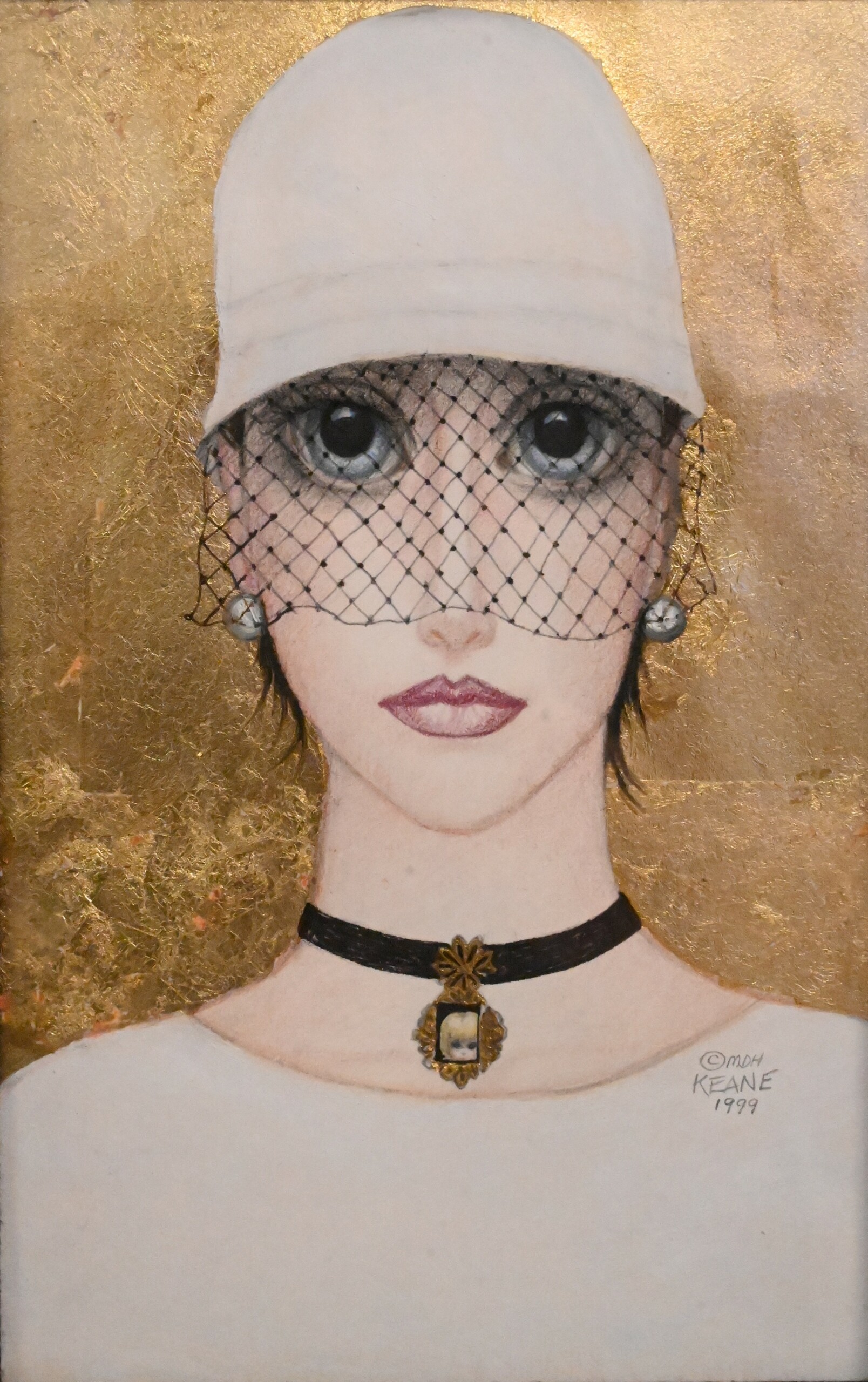
Margaret Keane (American, 1927–2022)
Woman in White with Veil and Cameo, 1999
Mixed media, colored pencil, gold leaf on paper, signed and dated lower right
Mixed media on panel, signed and dated lower right. This late portrait by Margaret Keane reflects her mature refinement and signature style. The young woman’s large, expressive eyes—Keane’s hallmark—are set against a radiant gold-leaf background, her pale attire contrasted by a black veil and choker that balance innocence with sophistication. The gold ground lends the work a reverent, icon-like quality, while the cameo hints at themes of identity and memory. Painted in 1999, nearly fifty years after her early “Big Eyes” pieces, the work captures Keane’s enduring sensitivity and mastery of emotion through the quiet power of the gaze.

