
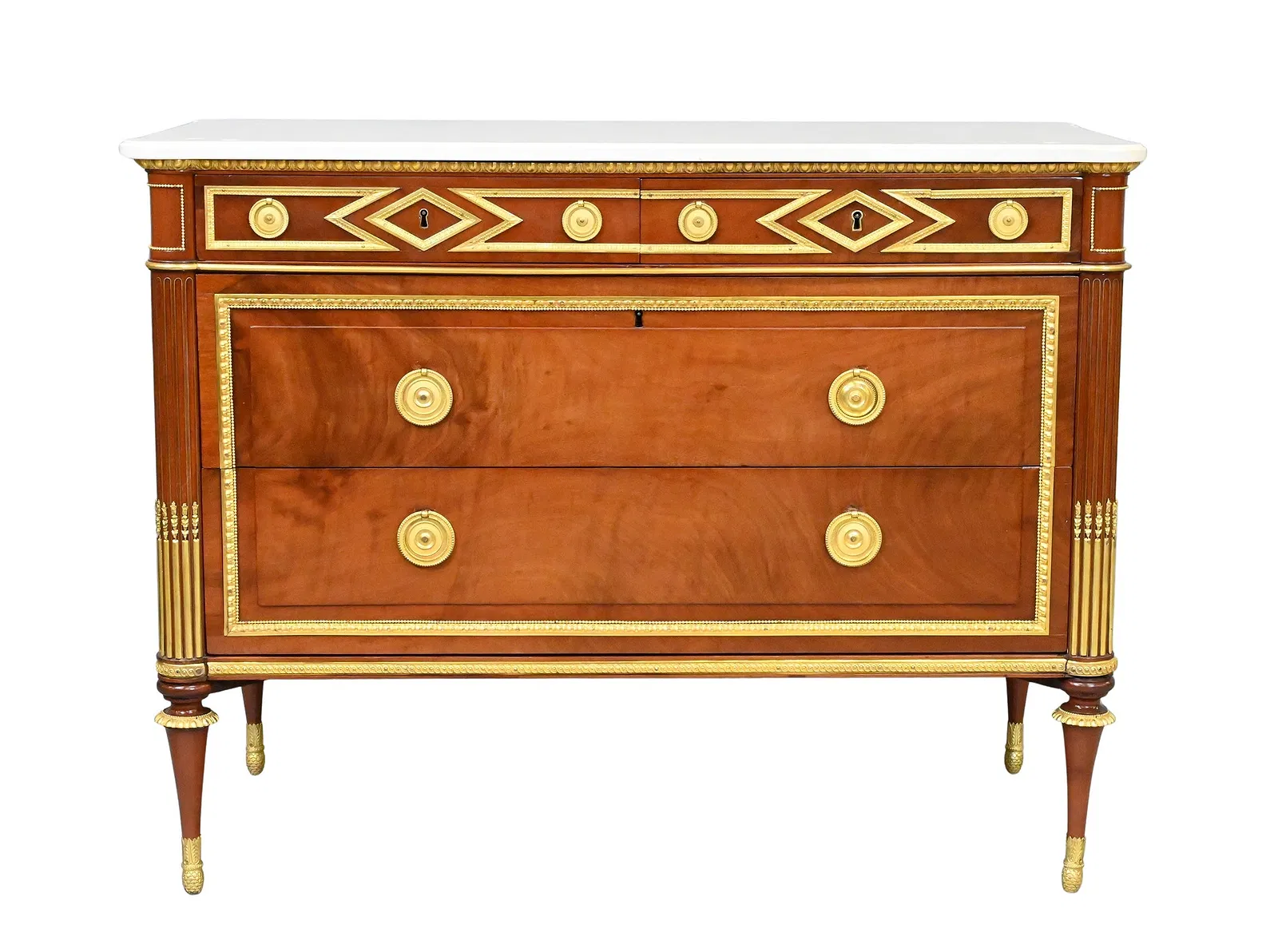
This refined Louis XVI mahogany commode, attributed to Claude-Charles Saunier, represents the height of Parisian neoclassical furniture design in the final decades of the 18th century. Executed circa 1785, the commode is distinguished by its architectural clarity and disciplined proportions, with a rectangular stone top resting above a balanced arrangement of two frieze drawers and two long drawers. The overall form reflects the Louis XVI preference for symmetry, classical restraint, and precision of line.
The richly figured mahogany veneers provide a warm, lustrous ground for the finely cast and chased gilt-bronze mounts. Diamond-patterned inlay, beaded and rosette mounts, fluted corner stiles, and tapered legs terminating in gilt-bronze sabots are all executed with exceptional refinement. These details demonstrate the technical sophistication of leading Parisian ébénistes, for whom bronze mounts were not merely decorative accents but integral elements of the design, reinforcing both structure and visual rhythm.
Claude-Charles Saunier’s workshop was particularly admired for its ability to unite classical silhouettes with luxurious materials, a combination that appealed to elite patrons across Europe. Through influential marchand-merciers such as Dominique Daguerre, Saunier supplied furniture to some of the most important houses of the period, including commissions for major British collections. Comparable works were delivered to the Spencer family at Althorp, underscoring Saunier’s international reputation and the prestige associated with his production.
The provenance of the present commode firmly supports its status as a significant and purpose-made commission. It was almost certainly acquired by John Alexander for Longleat, where it formed part of a larger suite of Louis XVI furniture. The commode is documented in the Longleat inventories of 1869 and 1896, described in both as a mahogany commode with ormolu mounts and a marble top, attesting to its long-standing importance within the household furnishings.
In more recent history, the commode passed through notable modern collections, including a private interior designed by Cullman & Kravis, and was sold at Sotheby’s, New York, in 2006, following its earlier appearance at Christie’s in London in 2002. Offered now at auction, this commode brings together aristocratic provenance, scholarly documentation, and the timeless elegance of French Louis XVI design, making it an exceptional opportunity for collectors of museum-quality furniture.

